
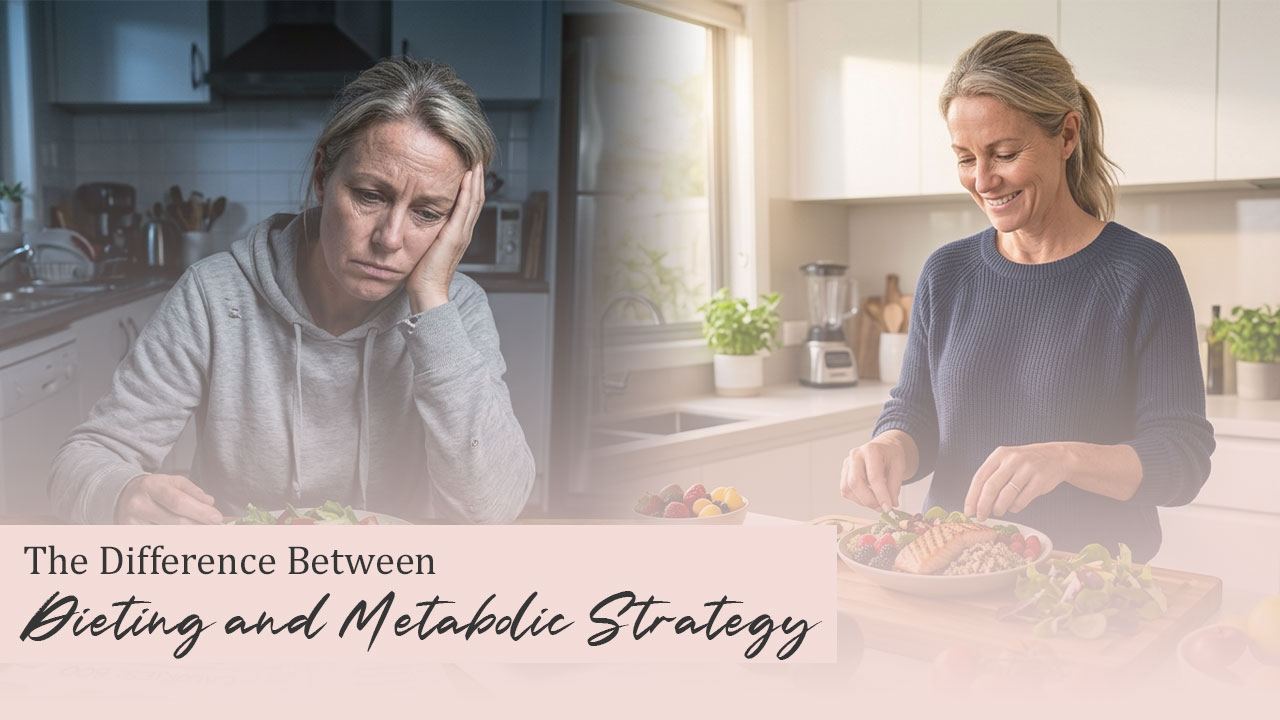
Dieting vs. Metabolic Strategy: Why One Works and One Doesn't
You've done the diets. Maybe more of them than you can count.
Keto. Calorie counting. Intermittent fasting. The 30-day reset. The 1,200-calorie plan your doctor mentioned once in passing. You followed the rules, you white-knuckled through the cravings, and for a while, maybe, something shifted.
Then it stopped working. Or you stopped being able to sustain it. Or the weight came back faster than it left, and now your body feels even more resistant than it did before.
Here's what nobody told you: that's not a willpower problem. That's what dieting does.
There is a fundamental difference between dieting and having an actual metabolic strategy, and understanding that difference may be the most important thing you do for your health in the years ahead. Not just for your weight, but for your energy, your hormones, your brain, and how you age.
Let's break it down.
1. What Dieting Actually Does to Your Body
Dieting, in the traditional sense, is built on one premise: eat less, move more, create a calorie deficit. On paper, the math makes sense. In practice, your body has a very different response.
When you restrict calories significantly, especially repeatedly over time, your body interprets it as a threat. Not a wellness choice. A survival situation. And it responds accordingly:
Metabolism slows to match the new, lower intake
Lean muscle mass breaks down for energy (lowering your metabolic rate further)
Hunger hormones like ghrelin increase sharply
Leptin, the hormone that signals fullness, drops
Cortisol rises, driving fat storage, especially in the abdomen
Thyroid hormone conversion slows, reducing energy expenditure
The result is that your body becomes more efficient at surviving on less, which is the exact opposite of what you want when you're trying to lose fat. This is called metabolic adaptation, and it's why the same diet that worked at 32 produces almost nothing at 42.
Dieting doesn't fail because you fail. It fails because it was never designed for how your body actually works.
Not Sure Where Your Metabolism Stands?
Take the free Metabolic Reset Quiz to identify your metabolic pattern and hormone-stress profile in just 3 minutes.
2. What a Metabolic Strategy Actually Is
A metabolic strategy starts from a completely different question. Instead of asking 'how little can I eat to lose weight?' it asks: 'what does my body need to function optimally, and what's getting in the way?'
It treats your body as a system. A complex, interconnected system where hormones, blood sugar, sleep, stress, muscle mass, gut health, and nutrition all influence each other in real time. Pull one lever without understanding the others, and the system compensates in ways that often work against you.
A true metabolic strategy includes:
Data and context, understanding your hormones, insulin sensitivity, inflammation levels, thyroid function, and nutrient status before making a plan
Hormone awareness, recognizing how estrogen, progesterone, cortisol, and insulin affect fat storage and energy, and working with those patterns
Muscle as a metabolic asset, building and preserving lean mass to raise your resting metabolic rate
Blood sugar stability, structuring nutrition to prevent insulin spikes that drive fat storage, rather than simply cutting calories
Stress and cortisol management, addressing the hormonal stress response that many women don't realize is their biggest fat-storage driver
Sleep optimization, because even a perfect nutrition plan cannot override the metabolic damage of chronic poor sleep
Personalized, adjustable approach, built around your body's specific responses, not a generic template
Notice what's not in that list: a calorie target handed to you without context.
3. Why Women Over 35 Need Strategy, Not Just Discipline

This distinction matters for everyone. But it matters most for women in perimenopause and the years leading into it, roughly 35 to 55, because this is when the hormonal landscape shifts dramatically, and the old rules stop applying entirely.
Here's what changes:
Estrogen decline changes where fat is stored
As estrogen drops, the body shifts fat distribution from the hips and thighs toward the abdomen. Visceral fat, the kind stored deep around the organs, is hormonally active and metabolically disruptive. It increases inflammation, worsens insulin resistance, and is more resistant to calorie restriction than subcutaneous fat.
Progesterone changes affect appetite and water retention
Lower progesterone means more bloating, changes in appetite regulation, and disrupted sleep, all of which feed back into metabolism and weight. Dieting doesn't address any of this. It often worsens it by raising cortisol further.
Muscle loss accelerates
Women lose muscle mass more rapidly during perimenopause due to hormonal changes. Dieting without resistance training accelerates this loss. And less muscle means a lower resting metabolic rate, meaning you burn fewer calories at rest, making weight management progressively harder.
Insulin sensitivity declines
Estrogen plays a significant protective role in insulin sensitivity. As it declines, the cells become less responsive to insulin, blood sugar management becomes harder, and fat storage signals increase. A diet high in refined carbs and sugar, even at a caloric deficit, will drive more fat storage in this hormonal context than it would have a decade earlier.
Dieting treats these changes as irrelevant. A metabolic strategy treats them as the starting point.
Your Hormones Are Part of the Equation.
At Healthy by Holly, we build personalized metabolic strategies around your lab data, hormonal patterns, and lifestyle, not a one-size-fits-all plan.
Schedule Your Free Strategy Session
4. The Six Biggest Differences Between Dieting and Metabolic Strategy
Restriction vs. Optimization
Dieting asks: how much can I cut? Metabolic strategy asks: what does my body need to function better? One creates deprivation. The other creates a sustainable foundation. The goal shifts from 'surviving on less' to 'running on more efficiently.'
Generic vs. Personalized
Most diets are the same plan handed to everyone, a calorie target, a food list, a set of rules. A metabolic strategy is built around your specific hormone levels, your insulin sensitivity, your stress load, your sleep quality, and your history. What works for someone else may actively work against you.
Short-Term vs. Systemic
Diets have end dates. You do them until you hit a number on the scale, then you stop. Metabolic strategy is ongoing recalibration, adjusting nutrition, movement, sleep, and stress management as your body changes, your hormones shift, and your life evolves. There is no 'after.' There's just a smarter way to live.
Willpower vs. Biology
Dieting is framed as a discipline problem. Metabolic strategy recognizes that cravings, energy crashes, and fat storage are biological responses, driven by hormones and blood sugar, that cannot be overridden by sheer determination. Fix the biology, and the behavior becomes far easier to sustain.
Scale vs. Body Composition
Diets focus on the number on the scale. Metabolic strategy focuses on body composition, specifically the ratio of fat to lean muscle mass. You can lose weight on a crash diet and end up with a higher body fat percentage than when you started, because you lost muscle. That is the opposite of metabolic progress.
Cortisol Up vs. Cortisol Down
Extreme calorie restriction raises cortisol, the stress hormone that signals your body to hold onto fat, especially in the abdomen. Metabolic strategy, which includes adequate eating, stress management, and quality sleep, keeps cortisol in a range that supports fat loss rather than blocking it.
5. What Metabolic Strategy Looks Like in Practice
This isn't abstract. Here's how the practical difference plays out day to day:
Instead of skipping breakfast to cut calories, you eat a protein-forward morning meal to stabilize blood sugar, reduce cortisol, and preserve muscle mass.
Instead of long cardio sessions to burn more, you prioritize strength training 2–3 times per week to build metabolic tissue that burns calories around the clock.
Instead of cutting all carbs, you pair carbohydrates with protein and fat to blunt insulin spikes and support energy without fat storage signals.
Instead of ignoring stress because it isn't 'a food issue,' you recognize that elevated cortisol is driving your cravings, your sleep disruption, and your belly fat, and you address it directly.
Instead of pushing through on 5 hours of sleep to hit the gym, you understand that poor sleep raises ghrelin, lowers leptin, and derails fat loss more than missing a workout.
Instead of guessing, you use lab data to understand what your thyroid, hormones, insulin, and inflammation markers are actually doing, and you adjust accordingly.
Metabolic strategy is not harder than dieting. It is more informed. And because it works with your biology instead of against it, it is exponentially more sustainable.
6. Why Most Women Don't Know This Exists
The diet industry is a multi-billion dollar business built on products, programs, and plans that work just well enough to keep you coming back. Short-term results followed by weight regain is not a failure of the model, it is the model.
Functional and metabolic health, on the other hand, is not a product. It's a practice. It requires understanding individual physiology, interpreting lab data in context, and building a strategy that addresses root causes rather than surface symptoms. It requires a practitioner who thinks in systems, not in checklists.
This is why so many women spend years, and significant money, cycling through diets that produce diminishing returns, while the underlying hormonal and metabolic picture goes completely unaddressed.
It's not that the answers don't exist. It's that they're rarely offered in the conventional model of care.
Final Thoughts
If you've tried to diet your way to better health and hit a wall, that wall has a name: metabolic adaptation. Your body was doing exactly what it's designed to do when it perceives threat and restriction.
The path forward isn't a stricter diet. It's a smarter strategy, one that understands your hormones, respects your biology, and builds something you can actually sustain for the decades ahead.
Your metabolism isn't broken. It's just been handed the wrong instructions.
Ready to Stop Dieting and Start Optimizing?
Healthy by Holly offers clinically guided metabolic strategy for women who are done with the cycle. Take the quiz or schedule a free session to get your personalized roadmap.
Schedule a Free Strategy Session
FAQs
1. What is the difference between dieting and a metabolic strategy?
Dieting focuses on calorie restriction as a short-term intervention. A metabolic strategy addresses the underlying hormonal, inflammatory, and physiological drivers of fat storage and energy, building a sustainable, personalized approach rather than a temporary fix.
2. Why does dieting stop working as you get older?
Hormonal shifts, especially estrogen and progesterone decline in perimenopause, alter insulin sensitivity, fat distribution, muscle mass, and cortisol response. These changes make the body significantly less responsive to simple calorie restriction and more responsive to a comprehensive metabolic approach.
3. Can I lose weight without dieting?
Yes, but it requires addressing the real drivers of fat storage, not just cutting calories. Blood sugar stability, hormone balance, stress management, quality sleep, and preserving muscle mass all have a direct and measurable impact on body composition, independent of calorie counting.
4. How does cortisol cause belly fat?
Cortisol, the primary stress hormone, signals fat cells in the abdomen to store more energy as a survival response. Chronic elevation, from stress, under-eating, poor sleep, or over-exercise, keeps this signal active, making abdominal fat loss extremely resistant to conventional dieting.
5. How do I start building a metabolic strategy?
The best starting point is clarity, understanding what your hormones, insulin sensitivity, inflammation, and thyroid function actually look like. From there, a personalized strategy can be built around your specific patterns and goals. At Healthy by Holly, we offer comprehensive lab-informed metabolic optimization programs designed for exactly this.